Showing posts with label Siamese. Show all posts

Saturday, February 12, 2022

Siamese attacked Kedah in 1821

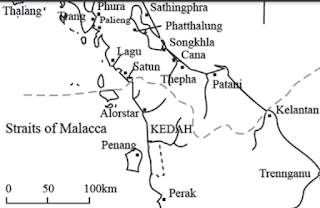
Kedah, a port polity between the Indian Ocean and the South China Sea, was a strategic point of the East-West trade. Kedah with its ship-building centers and food resources was vital to the strategy.

On 12th November 1821, a large Siamese fleet sailed into Kuala Kedah massacred the garrison there and sailed on to Kuala Merbok looking for Sultan.

On that day, a large fleet of Siamese ships unexpectedly anchored off Kedah’s main port of Kuala Kedah. But soon the real objective of the Siamese visit became apparent when a heavily armed landing party slipped ashore, supported by more troops entering Kedah’s inland frontiers from the northern and eastern borders. It was well coordinated, swift and cruel. A full-scale military invasion left the country in ruins.

The Siamese failed to capture their main target, Sultan Ahmad Tajuddin of Kedah, who was compromised in Siamese eye by “treason correspondence with the Burmese”. The Sultan escaped because at the time of the attack he was away in the south of Kedah, with most of his family and following, superintending the building a channel to link the Merbau and Muda Rivers. The messenger bearing news of the Siamese assault reached the Sultan only just ahead of his pursuers.

During the years that followed 1821-1839 Bangkok set-up direct control over her former tributary with a Siamese governor and a handful of Siamese officials to run the state as a Siamese province and a standing army to back up the authority of the new rulers.

In 1896, Kedah along with Perlis and Setul was combined into the Siamese province of Monthon Syburi which lasted until transferred to the British by the Anglo-Siamese Treaty of 1909.
Siamese attacked Kedah in 1821
Tuesday, February 27, 2018

Ten Lui Mei

Ten Lui Mei is today presumed to be the Chinese name for Tenasserim province. The name Tenasserim is believed, like Phuket to originally be a Malay name derived from “Tanahsari” or “land of the Fragrant Aloe woods”.

Tenasserim provinces has a climate an environment more closely akin to those of Island Southeast Asia (Indonesia and Malaysia) than to continental Burma, has abundant tropical fruits such as coconuts, durians, mangosteens and rambutan.

Historically Tenasserim included the whole deserted but thickly forested northwestern peninsular coasts from roughly Phuket up to Tavoy in Burma today.

In 1460s, Ayutthaya controlled Tenasserim along with its twin port of Mergui which had the best natural harbor on this coast.

Even of the Tenasserim region was successfully claimed and conquered by both Thai and Burmese kingdom during history, it was never the place for actual integration to the “states”, rather a buffer zone between them.

The Mergui Archipelago lies along the southern part of the Tenasserim coastline on a north to south axis. It extends in the north to the littoral town of Dawei and to the South as far as Phuket in Thailand. Its islands are inhabited at least since the seventeenth century by the Moken, a populating of sea nomads of Austronesian origins. The term Moken is used for all the tribes in the region that speak the Malayic language.
Ten Lui Mei

Sunday, June 14, 2015

Green Queen of Pattani

Pattani was a prosperous kingdom because of international trade. After the death of Sultan Bahadur in 1584 his daughters Raj Hijau, Raja Biru, Raja Purple and Raja Yellow became successive princess.

The Green Queen (Ratu Hijau) reigned as the sovereign queen of the State of Pattani from 1584 to 1616.

The Green Queen was quite well known in the Chancelleries of Europe Ayudhya and Japan. She brought peace and great prosperity to Pattani, promoting agriculture and building dams and canals.

The king of Japan sent envoys asking for permission to have trade and commercial relations with sultanate of Pattani, Green Queen granted the request in 1592.

In 1603, King Naresuan, the great emperor of Ayudhya launched first Siamese attack against Pattani. Pattani was supported both materially and morally by foreigners who were in Pattani then, specially the Portuguese and Dutch.

Hendrik Jansen, a Dutch merchant who was in Pattani reported that Green Queen, died in 28 August 1616 after she had rule Pattani for 32 years.
Green Queen of Pattani

Sunday, April 12, 2015

Tambralinga attack Sri Lanka (1247)

Tambralinga was a kingdom comprising a considerable area of the Malay Peninsula with Ligor as its capital. Tambralinga became an important center of the Thevada Buddhist School. Pali literature from Sri Lanka regarded Tambralinga as important twelfth century center of Buddhist scholarship.

After the invasion of Rajendra Cola the Srivijaya kingdom has hardly any political control over the Malay Peninsula. Until the thirteenth century Tambralinga was a pivot in politics of the southern Bay, also having asserted its independence on the century.

Dharmaraja Chandrabhanu was a king of the Tambralinga which active period 1230-70. In 1247 he sent an expedition to Sri Lanka with the ostensible aim of obtaining a Buddhist relic and controlled the northern part of the islands.

Dharmaraja Chandrabhanu spent more than 30 years in the conquest of Sri Lanka.

But its move to take over the whole island was frustrated by the Pandyans from south India who attacked Tambralinga in alliance with Ceylon. In 1270 Chandrabhanu attacked Sri Lanka again and was defeated by the Pandays badly enough that Tambralinga had not recovered when attacked by the Siam twenty years later.

Its rapid rise to prominence since the 13th century till beginning of 14th century, Tambralinga had occupied the entire Malay Peninsula and become one of the dominant Southeast Asian States.

By the end of the 14th century, Tambralinga had become part of Siam named Nakhon Si Thammaraj.
Tambralinga attacks Sri Lanka (1247)

Monday, March 30, 2015

Yellow Queen of Pattani

The Kingdom of Pattani prospered through increased trading with Chinese, Dutch Portuguese and English merchants and reached it zenith under the leadership of its four great queens: the Green, Blue, Purple and Yellow Queens.

Raja Kuning (reign 1635-1688) daughter of Raja Ungu was the last queen of Pattani. Know as the Yellow Queen her reign was marked by the decline of Pattani.

The queen adopted a peaceful coexistence with Siam asking for the mediation of the Sultan of Kedah. She visited Ayudhya in 1641 and was welcomed by King Prasat Thong.

She accepted nominal suzerainty of Ayudhya and sent bunga mas or gold leaves as a sign of tribute.

During Yellow Queen period Pattani attempted to establish relationships with other states through its marriage policy. One result of Pattani’s efforts to broaden its circle of power relations was that the struggle over the throne of Pattani became more complicated.

Yellow Queen died in 1688. With the inevitable passing of the Yellow Queen, kingdom started to decline and fell fully under the control of Siam by the latter 18th century under the reign of Rama I.
Yellow Queen of Pattani

Thursday, November 20, 2014

History of Perlis

Perlis was originally part of Kedah, though it variously fell under Thai and Acehnese sovereignty. In 1821, Siam had annexed Kedah.

The sultan of Kedah made unsuccessful attempts to regain his territory until, in 1842, he agreed to Siamese terms.  The Siamese withdrew their military forces from Kedah and Sultan Ahmad Tajuddin Halim Syah was reinstated to the Kedah ruling house.

The price Kedah paid was that the part of the state bordering Siam was sliced off to create the state of Perlis. Perlis then became a separate vassal principality state under a governor, Syed Hussain Jamalulail.

On 20 May 1843, the Siamese made Syed Hussain Jamalulail, maternal grandson of the Sultan of Kedah, became the first Raja of Perlis and he was obligated to send the triennial Bunga Emas to Bangkok as acknowledgement of Siam’s suzerainty.

The Siamese reinstalled the sultan but made Perlis into separate vassal principality with its own raja.

The British exerted pressure on Siam and in 1909, by the Treaty of Bangkok, the Siamese ceded their Malay dependencies (Perlis, Kedah and Terengganu). A British Resident later was installed at Arau.
History of Perlis

Saturday, May 3, 2014

History of Singgora (Songkhla)

Songkhla known in historical sources with different spellings such Saingor, Cingor, Singor, Singora as well as Sangor or Singgora, was in the seventeenth century considered an ideal port with its ample shelters for large vessels.

Arab sources cited that southern Songkhla was a seat of Hindu Malay Kingdom, Langkasuka. Langkasuka was first mentioned in the 5th century AD in the ‘History of the Laing Dynasty’ in China in reference to Lang-ya-hsiu, which had sent an embassy to China in 515 AD.

By the seventh century AD, the area of Langkasuka had become part of the Srivijaya kingdom, including Songkhla.

By 1593 Songkhla had been place under the suzerainty of the re-unified Ayutthaya under King Naresuen. 

At the latest by 1642 it was rules by a Muslim who was described by a French visitor as ‘the king of Songkhla’.

Under flourishing trade promoted by Muslim traders, Songkhla quickly developed economically and emerged as a strong political power in the Peninsula.

In 1652 the ruler, a Muslim, refused to come to Ayutthaya to serve public allegiance to the Thai king. In one of the many fierce campaigns which followed, a Thai fleet was dispatched, each vessel smeared with human blood and hung with human heads to terrify Songkhla into obedience.

By 1679 its ruler had finally complied with the order to go to Ayutthaya to pay personal homage.

In 1684 Songkhla was sending her tribute to the neighboring Muslim sultanate of Patani which in her turn, was sending tribute to Ayutthaya.

In 1791, Tengku Lamiddin, king of Patani rebelled against Ayutthaya. The Patani attacked Songkhla. The governor of Songkhla fled to Phatthalung and asked help from Ayutthaya. 
History of Singgora (Songkhla)

Wednesday, July 31, 2013

History of Terengganu

The word of Terengganu derived from word ‘taring anu’ where ‘anu’ means tiger. It was also said that Terenggani is Tamil word meaning ‘hilly country’, the name given many centuries ago by Tamil traders. 

Terengganu is the place where Islam first touched Malay shores. It happened even before Malacca had established itself as the peninsula’s first Malay kingdom.

In the 14th century the Thaïs occupied northeastern Malaya (Terengganu). Terengganu was formally established as a state in 1724.

The first Sultan was Tun Zainal Abidin Paduka Maharaja, a younger brother one of the former sultans of Johor. He used the title Sultan Zainal Abidin I. In 1850 Siam forced Terengganu into vassalage.

In 1909 an Anglo-Siamese treaty saw power pass to the British. It was an unpopular move locally. The campaign of resistance began in 1922 with a series of anti-tax protest organized by the village imams and spearheaded by two charismatic ulamas Sayyid Sagaf and Haji Drahman.

It was quickly put down and the British went about consolidating their power in the state until the Japanese invaded in World War II.
History of Terengganu

The most popular articles

Selected articles