Showing posts with label Kedah. Show all posts

Sunday, October 30, 2022

Chola dynasty of India

The Tamil Chola dynasty first emerged in southern India in 300 BC. They were based in the Cauvery valley, in the cities of Tanjore (Thanjavur) and Uraiyur

Vijayalaya was the founder of the Chola Empire. He defeated the Pallavas and took over the Tanjore kingdom within the 8th century and led to the establishment of the mighty Chola kingdom. Granted natural access to the Indian Ocean, the Cholas gradually carved out a strong maritime and mercantile empire, leveraging their position as a midpoint between China and Rome.

The Chola dynasty rose to prominence in 850 CE under the leadership of Vijayalaya Chola, and reigned for about four hundred years. King Rajaraja (reigned 985–1014 CE) took the empire to its height. He conquered the Maldive Islands and parts of Sri Lanka during the 10th century CE.

Both Raja Raja Chola and his son Rajendra Chola had established maritime contacts with the Sri Vijaya kingdom. At the time, the Srivijaya Empire was the dominant power in the Malay Archipelago, its lands consisting of Sumatra, the Malay Peninsula and parts of Java.

In 1025, Rajendra Chola launched naval raids on ports of Srivijaya and against the Burmese kingdom of Pegu. A Chola inscription states that he captured or plundered 14 places, which have been identified with Palembang, Tambralinga and Kedah among others. They also captured its king, Sri Mara Vijoyatunga Varman of Kadaram. The Bujang Valley was originally called Kadaram (Kedah) and formed part of the larger territory of the then Sri Vijaya kingdom.

Rajendra was one of the few Indian monarchs to conquer territory outside the Indian subcontinent. Under his reign, the Chola Dynasty was expanded to its greatest extent, dominating trade throughout the Indian Ocean. He was the only Indian emperor to conquer lands beyond seas.

The year 1279 CE marked the end of the Chola Dynasty. The last Chola king, Rajendra Chola III, was defeated by Maravarman Kulasekara Pandyan I. And with this, the Pandyas established their rule in present day Tamil Nadu.
Chola dynasty of India

Sunday, March 6, 2022

Kulim in Kedah

Kulim is bordering to Pulau Pinang on the west, and north of Perak. Kulim evolved from a small settlement in the 1950s to a thriving town because it's located in the strategic location, close to the urban conurbation Bukit Mertajam and Penang State.

The name of Kulim town was derived from a species of tree Scorodocarpus dorneesis or its common name which is Kulim.

Kulim as a town was started in mid-18th century by 100 Malays who came from the Pattani province, southern Siam, and Thailand.

In the 1850 the immigrant tin miners from Larut Matang, Taiping and Selama started to develop Kulim as a town. By mid-19th century Kulim experienced a boom due to the discovery of tin ore. By 1890, there were 400 Chinese miners operating in Kulim.

At the end of the 1870, he was elected by Sultan Ahmad Tajuddin Mukarram Shah as the first Kulim Chinese Chief.

In 1888, there was a major incident in Kulim, dubbed ‘Beautiful Nyonya War’ (Perang Nyonya Cantik) or Kulim War (Perang Kulim). This incident started when the mining chiefs of Kulim fought over a popular Chinese lady of the time.

The chiefs mobilized their respective workers in this seemingly minor squabble escalated into a major riot.

Kedah only started to take serious action to tighten the security in the area after the Kulim War. The Kulim had affected the revenue farms there and also serious undermined the security of the state.

The direct consequences of this incident were the hiring of a British national (B.E. Mitchell) as the chief of police of Kulim (1890) by the ruler of Kedah, and the worsening economic problem of the state. Mitchell was successful in using his influence and power to return peace to the district and also established an active and influential police force.
Kulim in Kedah

Saturday, February 12, 2022

Siamese attacked Kedah in 1821

Kedah, a port polity between the Indian Ocean and the South China Sea, was a strategic point of the East-West trade. Kedah with its ship-building centers and food resources was vital to the strategy.

On 12th November 1821, a large Siamese fleet sailed into Kuala Kedah massacred the garrison there and sailed on to Kuala Merbok looking for Sultan.

On that day, a large fleet of Siamese ships unexpectedly anchored off Kedah’s main port of Kuala Kedah. But soon the real objective of the Siamese visit became apparent when a heavily armed landing party slipped ashore, supported by more troops entering Kedah’s inland frontiers from the northern and eastern borders. It was well coordinated, swift and cruel. A full-scale military invasion left the country in ruins.

The Siamese failed to capture their main target, Sultan Ahmad Tajuddin of Kedah, who was compromised in Siamese eye by “treason correspondence with the Burmese”. The Sultan escaped because at the time of the attack he was away in the south of Kedah, with most of his family and following, superintending the building a channel to link the Merbau and Muda Rivers. The messenger bearing news of the Siamese assault reached the Sultan only just ahead of his pursuers.

During the years that followed 1821-1839 Bangkok set-up direct control over her former tributary with a Siamese governor and a handful of Siamese officials to run the state as a Siamese province and a standing army to back up the authority of the new rulers.

In 1896, Kedah along with Perlis and Setul was combined into the Siamese province of Monthon Syburi which lasted until transferred to the British by the Anglo-Siamese Treaty of 1909.
Siamese attacked Kedah in 1821

Thursday, November 20, 2014

History of Perlis

Perlis was originally part of Kedah, though it variously fell under Thai and Acehnese sovereignty. In 1821, Siam had annexed Kedah.

The sultan of Kedah made unsuccessful attempts to regain his territory until, in 1842, he agreed to Siamese terms.  The Siamese withdrew their military forces from Kedah and Sultan Ahmad Tajuddin Halim Syah was reinstated to the Kedah ruling house.

The price Kedah paid was that the part of the state bordering Siam was sliced off to create the state of Perlis. Perlis then became a separate vassal principality state under a governor, Syed Hussain Jamalulail.

On 20 May 1843, the Siamese made Syed Hussain Jamalulail, maternal grandson of the Sultan of Kedah, became the first Raja of Perlis and he was obligated to send the triennial Bunga Emas to Bangkok as acknowledgement of Siam’s suzerainty.

The Siamese reinstalled the sultan but made Perlis into separate vassal principality with its own raja.

The British exerted pressure on Siam and in 1909, by the Treaty of Bangkok, the Siamese ceded their Malay dependencies (Perlis, Kedah and Terengganu). A British Resident later was installed at Arau.
History of Perlis

Saturday, August 21, 2010

Ancient Kedah

Ancient Kedah
Settlement in Kedah goes back to the Stone Age; some of the earliest excavated archaeological sites in the country are found near Gunung Jerai.

According to history there was a suggestion that Kedah name originated from the word Kataha or Kadaram or Kidaram which was apparently known in Southern India.

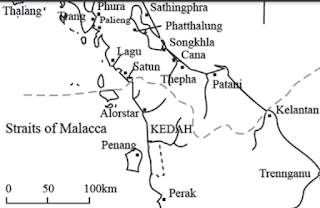
This happened during Chola monarch, Rajendra Chola (AD 1012-1052), dispatched several expeditions over the water to the East probably in defense of Tamil or Telegu settlements on the east coast of Sumatra and on the west coast of southernmost Burma, the isthmus of Kra and Malaya.

At that time the ships and merchants patronized Kedah due its strategic location facing the Bay of Bengal and also its natural safe anchorages. Kedah had emerged as an entrepot which witnessed the sale and purchase of merchandise, the layover of traders waiting for favorable winds before voyaging further and the establishment of store houses.

Kedah was known to Chinese as Chiecha. According to them, it was an important port in the 3rd century AD; it had a safe and excellent harbor at the mouth of the river Merbau.

The findings in Lembah Bujang date back to the Hindu-Buddhist period in the 4th century AD, and the current royal family can trace its line back directly to this time.

During the 7th an 8th centuries, Kedah paid tribute to the Srivijaya Empire of Sumatra, but later fell under the influence of the Siamese until the 15th century, when the rise of Melaka led to the Islamisation of the area.

According to Tome Pires (who spent time from 1512 to 1515 in Peninsular):
“Kedah is a very small kingdom, with few people and few houses. It is up a river. There is pepper there, a matter of four hundreds bahars a year. This pepper goes by way of Siam to China, with that which they bring from Pase and Pedir also. When any ship comes to Tenasserim and to the ports of Siam, it comes to Kedah to sell its merchandise also and the people from the tin districts buy and take good, because Kedah is trading country and they get to the land of Siam in three or four days by land, they take the merchandise from Kedah to Siam.”

In the 17th century Kedah was attacked by the Portuguese who had already conquered Malacca and by the Acehnese, who saw Kedah as a threat to their own spice production.
Ancient Kedah

The most popular articles

Selected articles