Showing posts with label Islam. Show all posts

Saturday, April 17, 2021

Arrival of Islam in Philippines

Arabic influence and the spread of Islam in the Philippines starts from Sulu brought by a sheikh who later married the daughter of the King of Sulu in the early 8th or 14th century.

It was also cited that a descendant of the Arab sheikh named Maldhum Karim or Tuan Sharif 'Awliya ' arrived in Sulu in the mid-14th century. He established Islam in the country through trade in several regions of the island.

After that came an Arab preacher named Sheikh Abu Bakr or sharif al-Hashim from Makkah. He was known as knowledgeable in theology and shari’ah. His mission was to spread out the doctrines of one Abu Ishaq embodied in the book Darul Madlum (The House of Oppressed) within Malay world.

The Sheikh Abu Bakr initiated attempts to convert the inhabitants of the interior of Sulu (Buranuns) and is believed to have been successful. The coastal peoples and those of the interior of Sulu became slowly integrated into a political community under a central authority.

Sheikh Abu Bakr belongs to a sharif lineage, which is one of the descendants of Prophet Muhammad SAW. Later, he was inducted as the Sulu sultanate and ruled for 30 years in 1450-1480. The establishment of the sultanate assumes that a great number of the coastal inhabitants of Sulu had become Moslems and therefore responsive to such as Islamic institution.

Another sultanate had emerged in Mindanao by 1520 established by Sharif Kabungsuwan. Islam spread to Mindanao brought by 'Ali Zainal Abidin who was also known as "Kabungsuwan" which was a descendant of Syed' Awlawiyyah who have family ties with relatives king in Johor. 'Ali Zainal Abidin arrived in Cotabato in 1475.

All these sultanates from Sulu and Mindanao eventually lost their powers upon the establishment of a modern republican government set up by the Americans, and upon the birth of the Philippine state in 1946.
Arrival of Islam in Philippines

Saturday, July 15, 2017

Islam in Brunei

Old Brunei was a nation of Malay Hindu-Buddhists, according to a Chinese account of Puli, believed to be an early Chinese reference to Brute Old Brunei was said to have similar Malay-Hindu Buddhist traditions and customs as Funan or Kumlum in Malay state of Indochina.

Islam is believed to have existed ever since the fourteenth century with the Islamization of Awang Alak Betatar, with the adapted Muslim name Sultan Muhammad Shah, as the first sultan to rule Brunei.(1363-1402).
Hence, Islamic law is assumed to have been practiced by Bruneian society. With Islam, Brunei asserted and expanded its role as an independent and dominant trading power in the region. Its trade and territories grew with the spread of Islam to encompass existing Malay kingdoms in Borneo and the Philippines.

Brunei participated in the intellectual network of Islamic South-East Asia and beyond through different channels Tariqahs, educational centers, political ties, trading network, religious figures and personal ties formed important nodes of networks.

Today, Islam, primarily of the Shafiite School of Jurisprudence, is alive and thriving in Brunei. Birth, marriage, divorce, burial and other social ceremonies in Brunei are generally done according to the Islamic law.
Islam in Brunei

Sunday, February 5, 2017

Islamization of Samudera-Pasai Kingdom

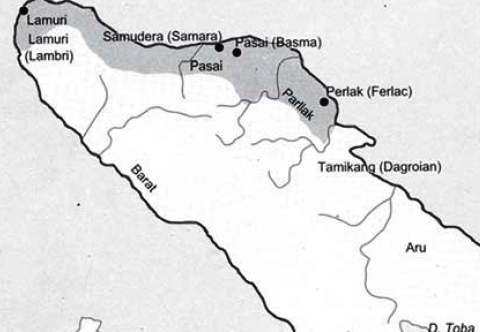
The Kingdom of Samudera-Pasai in northeastern Sumatra was among the first to embrace Islam at the end of the 13th century.

The Kingdom was established around the end of the 13th ce9utry, just before Polo’s visit to North Sumatra and became a prosperous port polity during the 14th and 15th centuries. The first king of Samudera –Pasai was Merah Silu, who later converted to Islam and adopted the name Malik ul Salih, in the year 1267 AD.

Since the hinterland of Pasai produced gold, camphor and from as late as the 15th century, pepper, connections with the inland people were very important to the city.

The conversion to Islam was significant to Pasai in order to attract Muslim merchants from west Asia and south India. During the governance of Sultan Malik al-Shaleh (1261-89) and Sultan Malik al-Dharir (1326-50), the large scale process of Islamization was under way, and Pasai could be described as the center of Islam and the center to which people came to seek reference in regards to religious matters.

This situation continued until Pasai stared to weaken publically after the rose of the Malacca kingdom. Portuguese invaded Samudera-Pasai Kingdom in the year of 1521.

Islamization of Samudera-Pasai Kingdom

Saturday, July 9, 2016

Makassar Malay

Makassar’s Malay traders were key handlers of Southwest Sulawesi’s main exports (rice and slaves) and of the spices shipped from Maluku to the Straits of Malacca.

Both Portuguese and Makassar sources state that by the early 16th century, Malay Muslim traders had settled in Makassar and other places on the southwest coast of Sulawesi.

There was a theory that the Malays certainly are well known for their role in spreading Islam to Makassar. The presence of a Malay community was impetus for Tunijalloq to build the first mosque in Mangallekana and encourage Muslims to make the hajj, for example.

It was a Minangkabau Malay named Katte Tungallaq who led Karaeng Matoaya and Sultan Alauddin Tumenanga ri Gaukanna in their profession of faith in 1605.

Malay frequently served as religious officials and teachers in seventeenth-century Makassar as well.  In 1638, VOC chief merchant, Henrick Kerckerink, described how European merchants were protected by the King, and noted that the local community of Malays was held ‘in high esteem, having their houses in the settlements scattered among the houses of the Makassarese’.
Makassar Malay

Sunday, February 14, 2016

State of Gowa

About 1530 the Makarese state of Gowa began to expand its power over its neighbours by conquest. By the mid-sixteenth century Gowa had established itself at the head of loosely united empire and had emerged as a major trading power in eastern Indonesian.

In 1605 the king of Gowa adopted Islam. The ruler of Gowa publicly pronounced the Islamic profession of faith in September 1605. In a society where rulers were the focus of social life and its norms, other Makarese quickly followed these rulers.

Apparently the invitation to the Bugis state of Bone and other states to adopt the new faith was rejected. Gowa responded with a series of campaigns in 1608-11, as a result which Islam was imposed throughout the Bugis-Makarese area.

During the seventeenth century these trends and the general pattern of Gowa’s expansion and rising power continued at an even swifter pace.

At the end of these wars Gowa was the predominant state of South Sulawesi. Its ‘empire’ like other Indonesian states, was founded on military supremacy but was not a tightly centralised system of domination.

Sultan Hasanuddin (reign 1653 to 1669) was the last independent ruler of Gowa, and the one who saw the debacle of the Makassar Wars (1666-1669), which ended in Gowa’s subjugation.
State of Gowa

Sunday, September 27, 2015

Islam during Malacca sultanate

As Islam spread down the coasts of Sumatra – being adopted by the courts of Aru and Deli in the 1400s, it also gained adherents on the peninsula.

It is the ruler of Malacca appears to have adopted Islam with encouragement of the lord of Pasai. According to Sulalat al-Salatin, the dynasty of Malacca was founded around 1400 by Parameswara from Palembang after an interim period in Temasik. It was a first a Hindu Kingdom in 1402 and later converted to Islam with the marriage of the princess of Pasai in 1409.

His marriage also encouraged a number of his subjects to embrace Islam. Later, Parameswara transformed the Hindu Kingdom of Srivijaya into a Muslim Sultanate – the Sultanate of Malacca. He assumed the title of Sultan Iskandar Shah.

Centered in the down town of Malacca, the sultanate stretched from Muslim Malaya settlements of Phuket, Setol, Pattani, bordering Ayutthaya Kingdom of Siam.

By 1413, Malacca had become a fully fledged Muslim sultanate. Islam became established throughout Malacca’s empire, by the end of the 15th century, included all the states of the Malay Peninsula and those on the east coast of Sumatera.

Islam became the region’s principal religion, its rise coinciding with the decline of the Buddhist Srivijaya and Hindu Majapahit empires.

Wealthy Muslim traders were drawn to conduct business there and Malacca also became a well-known center of Islamic scholarship.

The spread of Islam happened at the peak of Malacca’s glory between 1459 and 1477 during the reign of the sixth sultan, Mansor Shah.
Islam during Malacca sultanate

Monday, May 25, 2015

History of Kutai Kingdom

Kutai Kingdom is divided into two periods:
Kutai Martapura (350-400)
Kutai Kertanagara beginning around 1300

Kutai Martapura Kingdom was established in 400 AD under the king of Mulawarman Naladewa. Kutai Martapura is believed to be the oldest Hindu Kingdom in Indonesia, whose capital located in Muara Kaman.

The two successive kings of Kutai were Aswawarman and Mulawarman. They were descendents of the indigenous king, Kundunga.

Inscriptions in stone of found in east Kalimantan at a place now called Muara Kaman attest to this history as Brahmans erected stone memorial to express their gratitude and respect for the great king’s kindness, king of Mulawarnan who ruled from late in the fourth century.  The stone inscribed in Sanskrit, using the Pallava script and dated to around the 4th century.

Kutai demonstrates an early transition to Brahmanism, as Mulawarman reportedly staged scarifies and represented fabulous gifts to his recently settled Brahmans. These Brahmans probably had come from India or may have been Austronesian who had voyaged to India for their religious training.

Islam spread mainly along the coast but as there were no active missionary efforts people in the interior kept their traditional belief systems.

Sultanate of Kutai Kertanagara was established on the coasts near the town of Pamarangan. This sultanate was supposedly founded by refugees from the Javanese state of Singasari who had arrived late in the 13th century and converted the local inhabitant to Islam.

Under the reign of Aji Pangeran Sinum Panji Mendapa (1605-1635), Kutai Martapura was integrated into the expanding Sultanate Kutai Kertanagara in 1630 AD.
History of Kutai Kingdom

Sunday, April 26, 2015

History of Banjarmasin

Banjarmasin’s history reached back to when Indian traders founded the Hindu Negara Kingdom north of here during the thirteenth center.

Within seventy years, its rulers were marrying into the powerful Majapahit Empire and Banjarmasin was part of the Hindu kingdoms of Negara Dipa and Negara Daha, a vassal of Majapahit.  

Javanese-style court was established at Negara Dipa in the 13th century. By the 15th century the capital had move to Negara Daha and during these centuries the Hindu Banjar kingdom was a power along coast of Borneo.

The fall of the Majapahit in the late 1470s saw Negara disintegrate into small city-states.

These were unified fifty years later after a local prince Pangeran Samudera, enlisted military assistance from a recently Islamized Java and conquered the region, converting to Islam and shifting his capital south to the lower Barito River at Banjarmasin on 24 September 1526. Pangeran Samudera later became Sultan Suriansyah or Panembahan Batu Hambang.

The Dutch opened trade there in 1606. In the early 17th century, Kalimantan became a scene of conflict between the British and the Dutch, ostensibly over the British flourishing pepper trade.

By the late 1820s the colonizing Dutch had concluded treaties with various small west-coast states, including parts of the Banjarmasin sultanate.
History of Banjarmasin

Monday, March 2, 2015

City-state of Malacca

The Muslim city-state of Malacca was founded in 1401. Malacca developed during the fifteenth century into a wealthy entreport. The suburb was already home to a multi-ethnic community of merchants.

During the days of the Malacca Sultanate, these intrepid ancient seafarers not only came from neighboring regions but also from as far away as China, Japan and the Middle Eats to trade for the fabled Asian spices.

Four officials administered the foreign merchant communities: one for the Guajaratis, one for other Indians and Burmese, one for Southeast Asia, and one for the Chinese and Japanese.

Malacca, located in the west coast of the Malayan Peninsula, first emerged as a major trading port in the early fifteenth century, when Parameswara, avoided Thai rule with the aid of the emperor of China.

By 1500, Malacca was the largest and most populous commercial emporium in the international trade world of Southeast Asia. Malacca was the crucial transit point for spices and many other commodities heading east to China and west to India and Europe, and a port city quite dependent on the trade in pepper.

Malacca also became a center of Islamic learning from which scholars spread Islam throughout the region.
City-state of Malacca

Wednesday, July 31, 2013

History of Terengganu

The word of Terengganu derived from word ‘taring anu’ where ‘anu’ means tiger. It was also said that Terenggani is Tamil word meaning ‘hilly country’, the name given many centuries ago by Tamil traders. 

Terengganu is the place where Islam first touched Malay shores. It happened even before Malacca had established itself as the peninsula’s first Malay kingdom.

In the 14th century the Thaïs occupied northeastern Malaya (Terengganu). Terengganu was formally established as a state in 1724.

The first Sultan was Tun Zainal Abidin Paduka Maharaja, a younger brother one of the former sultans of Johor. He used the title Sultan Zainal Abidin I. In 1850 Siam forced Terengganu into vassalage.

In 1909 an Anglo-Siamese treaty saw power pass to the British. It was an unpopular move locally. The campaign of resistance began in 1922 with a series of anti-tax protest organized by the village imams and spearheaded by two charismatic ulamas Sayyid Sagaf and Haji Drahman.

It was quickly put down and the British went about consolidating their power in the state until the Japanese invaded in World War II.
History of Terengganu

Sunday, June 24, 2012

The spread of Islam in Pattani

Islam came to Pattani even before the Malacca sultanate was established. Many suggest that Islam spread to the region as early as the 10th or 11th centuries brought by missionaries from Langkasuka.

Islam came in the context of an Islamicate civilization brought by mystics and merchants. The former are associated with Sufism and the latter with more ritualistic Sharia’a based Islam of the Sunni Shafii school of jurisprudence.

Pattani was not known to the Islamic world before it was Islamized. A Pasai Muslim Sheikh Syafialudin once cured Raja Indra on the condition that he would be converted to Islam.

Raja Indra took the name Mahmud Shah with the title of Sultan. Islam spreading as far as north as Songkhla. The Malay dialect of Jawi became the main language of the deep south and Islam came to replace Buddhism in the region of southern Thailand.

The Pattani Sultanate was a populous and prosperous Muslim kingdom in the Malays Peninsula until it fell under Thai control in 1786.

It was suggested that the pondok system which was also developed in other parts of the Malay peninsula, originated from Pattani. The historians point out that the pondoks in Pattani were very prestigious and their more advanced students were welcome as teachers elsewhere.
The spread of Islam in Pattani

The most popular articles

Selected articles